


On 24 January at 3:00 pm, MUHK / the Estonian Agricultural Museum will open the exhibition “Look, I Shrunk the Collective Farm!”, bringing a highly detailed miniature collective farm into the exhibition hall at a 1:35 scale. The exhibition features Soviet-era tractors, buildings, tools, animals, and landscape elements, together forming a coherent picture of the collective farm environment of that time.
“What fascinates me most about this exhibition is the incredible level of detail in the miniatures. Every building, machine, and small element has been carefully thought through, and together they form an impressive whole. It is one of those exhibitions where you want to keep walking around the table, discovering something new each time. This mini collective farm will amaze visitors even if they have never seen a real collective farm in their lives,” says exhibition curator Laura Vähi.
The creator of the miniature collective farm is Taavi Leola, who works at the Estonian University of Life Sciences as a lecturer in farm technology and occupational safety, and as a designer of agricultural buildings. In recent years, his hobby has grown into an extensive and systematic creative practice. Its roots lie in researching his ancestors’ farm and in a desire to understand what buildings, machines, and everyday objects really looked like in their original form. The process of “shrinking” began with his grandfather’s scooter Sipelgas, continued with a sauna, and gradually developed into a complete miniature collective farm world.
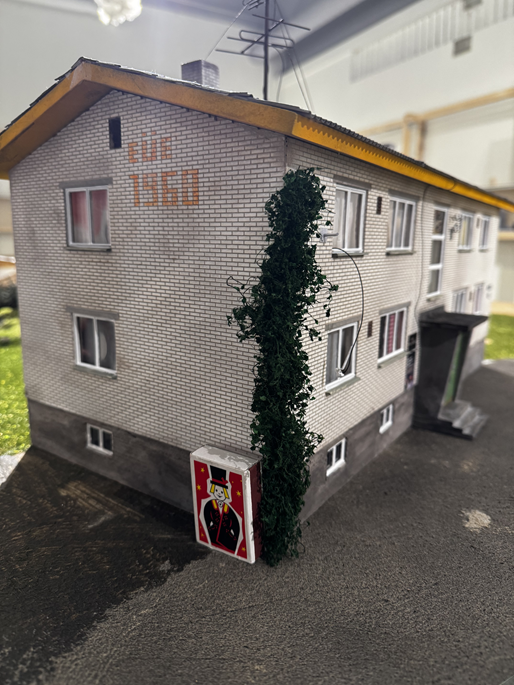
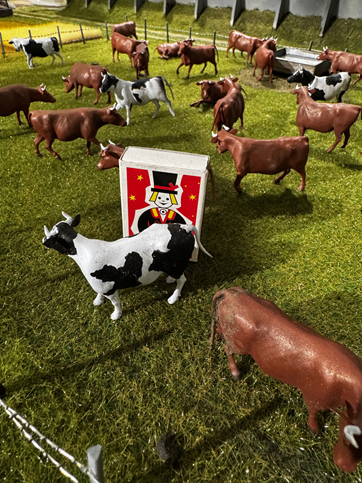
Taavi did not grow up on a collective farm himself, but machines seen in childhood, his studies, and the inherited family farm encouraged him to focus on this particular period. When creating miniatures, he uses surprisingly ordinary materials: coffee-stirring sticks become houses, sewer pipes turn into fuel tanks, solder wire becomes barbed wire, and drinking straws form chimneys and pipes. Sea kale becomes a tree, coffee grounds turn into asphalt, flax tow becomes hay, and even a Coop plastic bag is transformed into a flag. However, the true value lies not in the materials themselves, but in the time, research, and precision behind each object.
One of the exhibition’s special stories is the model of a combine harvester gifted to Elmina Otsman, created on the basis of historical photographs and thorough background research.
The model-making process includes idea development, 3D modelling, resin printing, hand-finishing, decal creation, and the careful shaping of a realistic, “worn” appearance. It is a long and detailed process, which is also explained in greater depth in the exhibition.
“Look, I Shrunk the Collective Farm!” is an exhibition for everyone interested in recent history, design, technology, craftsmanship, and visual storytelling. It offers plenty of moments of discovery and wonder.